
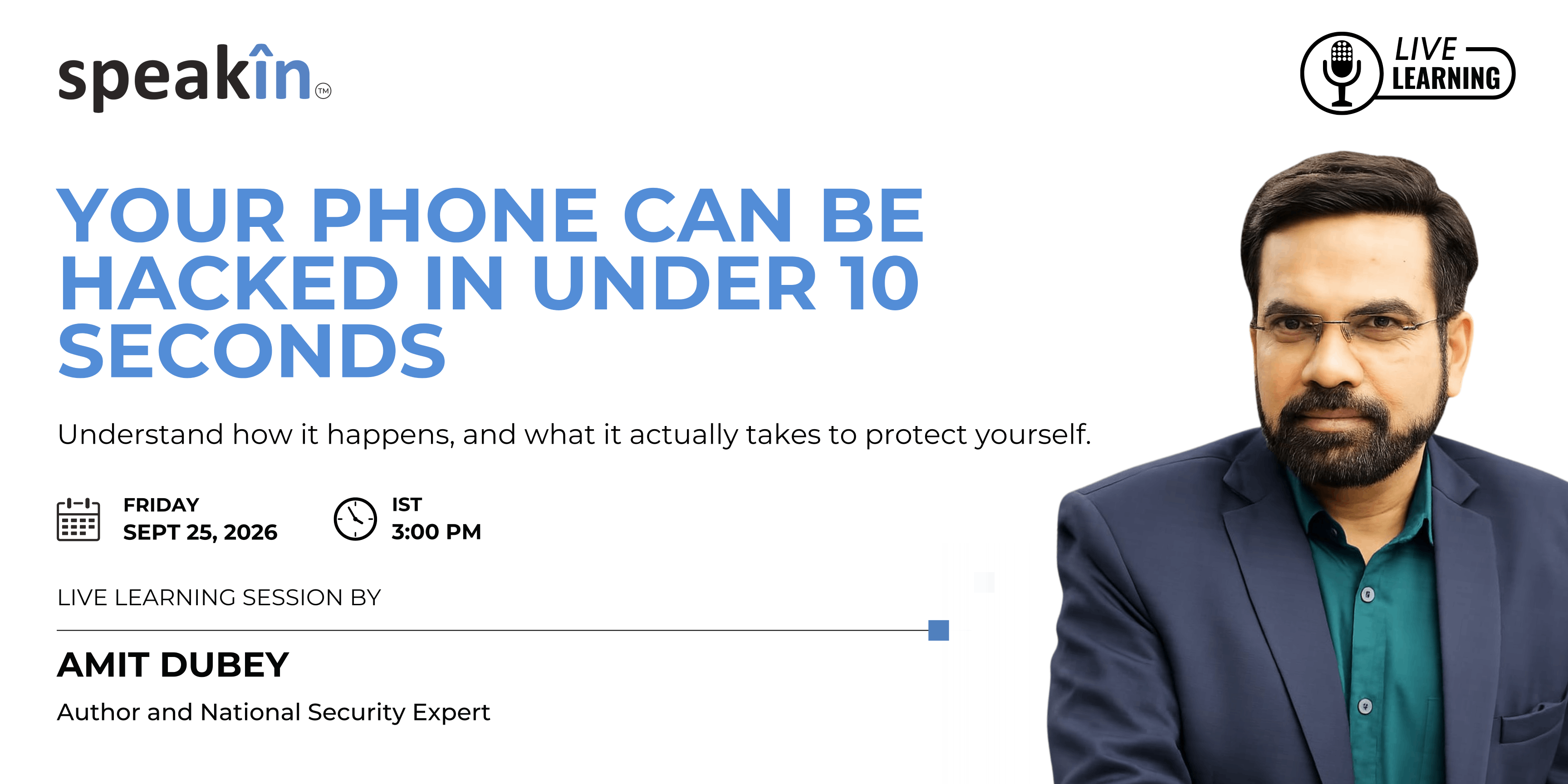
Speaker: Amit Dubey
Every smartphone, laptop, and connected device we use today is also a potential entry point for attackers, and most people have no idea how exposed they really are. This session pulls back the curtain on the world of cyber crime, offering a rare, unfiltered look at how attacks actually happen and how they are investigated. Drawing on decades of field experience, national-level policy work, and frontline investigative expertise, it moves beyond theory to show the real mechanics of modern cyber threats.
Participants will see live demonstrations of how quickly a mobile device can be compromised, understand the tools and techniques criminals use to exploit everyday vulnerabilities, and learn how digital forensic experts trace and reconstruct evidence in criminal investigations. The session also looks ahead, examining how artificial intelligence and quantum computing are beginning to reshape the cyber threat landscape, making attacks faster, more targeted, and harder to detect. Alongside this, it explores how India's cyber crime landscape is evolving, the specific threats facing individuals, financial institutions, and government bodies, and how the country's police, judiciary, and policy makers are working to keep pace.
This is not a session built around jargon or abstract risk. It is a practical, evidence-based briefing on where the real dangers lie, how investigators are responding, and what individuals and organisations can do differently to stay protected in an increasingly connected world. Whether you are a business leader responsible for organisational security, a professional who handles sensitive data, or simply someone who wants to understand the risks hiding behind everyday technology, this session offers insight you will not find in a typical cybersecurity briefing.
Mobile Device Vulnerabilities See firsthand how a smartphone can be compromised in mere seconds, and walk away with practical steps to shut those doors before attackers find them.
AI and Quantum Threats Discover how artificial intelligence and quantum computing are arming cyber criminals with faster, smarter, and harder-to-detect methods of attack.
Digital Forensics Basics Go behind the scenes of a criminal investigation and learn how experts trace digital footprints, analyse evidence, and build a case that holds up in court.
Cyber Crime Landscape in India Get a clear-eyed view of the threats actively targeting individuals, banks, and government institutions across the country right now.
Social Engineering and Fraud Uncover the psychological tricks and manipulation tactics criminals use to gain trust and steal data, often without the victim ever realising it.
Policy and Institutional Response Understand how India's government, police, and judiciary are building the systems and capabilities needed to fight cyber crime at scale.
Amit Dubey is one of India's most recognised cybersecurity voices — a National Security Expert who has advised Parliamentary Standing Committees, trained over 10 lakh police officers, judges, and bureaucrats across India and Southeast Asia, and demonstrated live mobile hacking in under 10 seconds on national television.
He serves on key government task forces under the Ministry of Electronics & IT and the Government of Uttar Pradesh, and has been invited by Indian defence forces to train their cyber professionals.
CNN-IBN recognised him as a National Security Expert, and he appeared on Kaun Banega Crorepati, introduced by Shri Amitabh Bachchan. He hosts "Hidden Files" on 93.5 Red FM, reaching 20 million weekly listeners, and runs a DD National TV show on cyber crime.